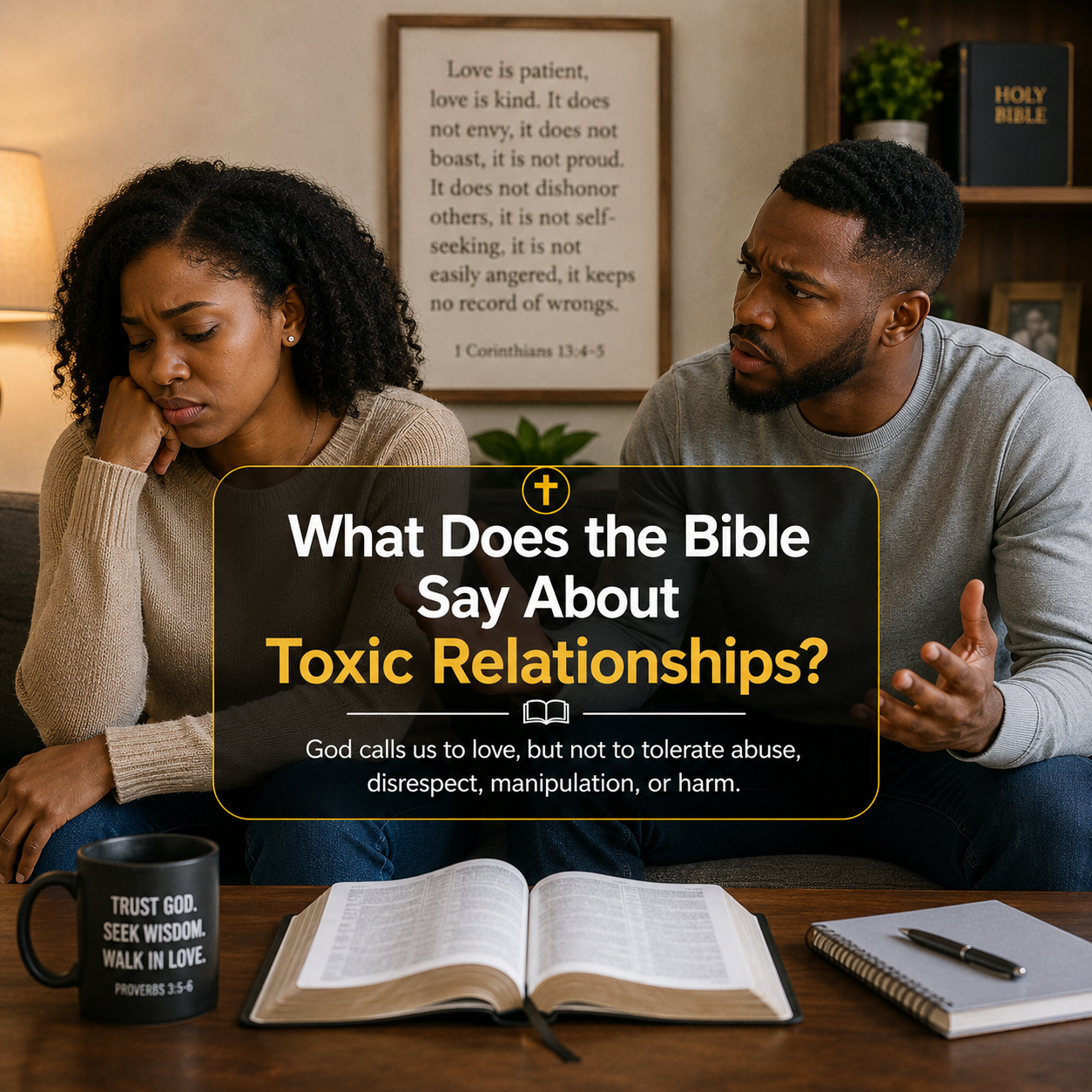
What Does the Bible Say About Toxic Relationships? Signs, Scripture, and What to Do
What the Bible says about toxic relationships is something that many believers don’t fully investigate, and it costs them years of avoidable pain in friendships, family, and romantic relationships as they slowly pull them away from the person God wants them to be.
The Bible doesn’t contain the word toxic. But the ideas behind it are most definitely. God’s Word has a lot to say about relationships that suck the life out of people, destroy their character, and damage their soul. It also has a lot to tell you about what to do once you’re in one.
This article will not give you the suggestion that it’s the godly thing to do to end every difficult relationship. It is also not going to tell you that the faithful Christians suffer abuse and mistreatment. The truth lives in a more honest place than either of those extremes, and that is the place we are going to explore together.
What Makes a Relationship Toxic From a Biblical Perspective
It’s important to know what a toxic relationship is before getting into the specifics of the Bible. A toxic relationship isn’t just a challenging one. There’s a time for every kind of relationship that runs into trouble. Finances are a stress in a marriage. A friendship weathers misunderstanding. There are old wounds in a family relationship. Just because it is difficult doesn’t make it toxic.
A toxic relationship is a relationship that is hurtful because of a recurring pattern of behaviour from one or both individuals. Not the pain from being challenged or the discomfort from honest conflict. But true damage to your emotional state, your spiritual life, your self-image and your functioning as God created you to do so.
In the Bible, the indicators of a toxic relationship are: ongoing deception, manipulation, contempt, cruelty under the guise of honesty, control under the guise of love, and a lack of accountability or willingness to change. These are not single acts of sin that a person truly regrets and strives to change. They are patterns.
It’s not always clear from the inside whether a relationship is failing or becoming toxic, which is why it is easy to remain in a destructive relationship for considerably longer than you should. When you’re emotionally tied to someone, your brain will tend to rationalize what you’re seeing, whereas some outer party would not be as understanding.
What Does the Bible Say About Toxic Relationships in Plain Terms
When people ask what the Bible says about toxic relationships, they are usually hoping for a specific verse that gives them permission to do what they already know they need to do. This is not always the case in the bible. However, its overall curriculum about relational health is very no-nonsense.
Proverbs 13:20 says that whoever walks with the wise becomes wise, but the companion of fools will suffer harm. There’s more to that verse than just intellectual wisdom. It is about the people that you let into your life on a regular basis. The Bible was aware of something that modern psychology has since proven. The influence you receive is the one from the people you are most connected with. When you are not aware of their thinking, their habits, their values, the ways they treat people, you are influenced by these, whether you know it or not.
If the best relationship that you have is constantly leading you away from God, away from growth, away from development, or away from kindness and lovingness, it is not a relationship that is helping you to become wise. It’s a hurtful relationship. And the Bible means it.
What the Bible does not do is give a simple formula for when to stay and when to go. What it does is provide you with the values and the structure for how you can make that discernment wisely and prayerfully and not in fear and/or guilt.
The Signs of a Toxic Relationship the Bible Addresses
You will not find a checklist in Scripture labeled signs of a toxic relationship. Throughout the book of Proverbs, in the Psalms and in the writings of Paul, the Bible illustrates a number of kinds of people and relational patterns that are clearly sufficient enough that you can identify them.
Persistent Dishonesty
The Bible takes the topic of a couple living in deception seriously. Proverbs has many cautions for someone whose word is untrustworthy, someone who says one thing and does another, someone who has a nice outside appearance but whose inner actions are not. It is spiritually and emotionally corrosive to be living in close relationship with someone who is constantly dishonest in dealing with you and the Bible does not ask you to just take it like that as a gift.
Consistent Contempt
One of the most hurtful things a man can say to another is that he despises him. It is the sustained message that the other person is inferior, worthless, or beneath serious regard. A relationship characterized by contempt, whether it comes through words, tone, dismissiveness, or public humiliation, is not one that reflects the love Paul describes in 1 Corinthians 13. The Bible never says that contempt is OK because it is coming from someone you love or who says they love you.
Control and Manipulation
There’s a type of relational control that’s disguised as love and concern. It tracks you, it keeps you in check with respect to who you are talking with, what you are thinking about your life and your decisions, and it views all of this keeping you in check as being good for you. Control is not a part of the Bible’s picture of love. As Scripture says, “Genuine love serves the other person’s flourishing, not manages it.
Patterns That Pull You From God
This one is important and rarely mentioned! If it is a relationship that is always drawing you away from prayer, community, Scripture, or from the person that God is creating you to be, then it is a relationship you should reconsider. Not all spiritual disagreements are bad. However, when the presence of that person is always a hindrance to your relationship with God, then the Bible has good reasons for you to reexamine that relationship.
What the Bible Says to Do When You Are in a Toxic Relationship
This is where the real question is. Knowing that a relationship is harmful is one thing. Knowing what to do about it is another, particularly if the person in question is a family member, a spouse or someone you have known for years.
The first directive of the Bible for you is to honestly look at yourself. Look at your heart before you decide on a relationship. Do you label as toxic that which is truly toxic, or just difficult and uncomfortable? All wise decisions start with honest self examination.
The second is the direct conversation, in which it is safe to have. Matthew 18 outlines a process of addressing relational conflict that begins with going to the person directly. A relationship problem that has not been openly discussed and resolved has not been dealt with. There are many relationships that are toxic and have problems in the middle that have been ignored by both parties.
The third thing is seeking counsel. A trusted pastor, a Christian counselor or a fellow believer who is mature and has known you for some time can provide a perspective you simply cannot obtain from the inside. Wisdom and counsel are not postage stamps on the Bible! It captures the truth that we need other people to help us in the most important relationships.
The fourth is to create distance; and with a relationship that has real harm in it, it’s distance. God doesn’t want you to live in a circumstance that’s hurting you. The word Gracious does not imply taking in all the damage. At times, wisdom involves pulling back, setting clear boundaries or even ending an entire relationship, especially when it comes to safety.
The Part Nobody Talks About in Church
This is something that hasn’t been addressed in most Christian content on this topic. Many Christians remain in bad relationships because they are NOT aware of the damage that is being done to themselves, but because they have been indoctrinated into a form of Christianity that makes it sound like it is unfaithful to leave or endure the relationship.
That one is not correct. Jesus went away from those who would harm Him when it was not yet His time. Paul singled out individuals by name as they were a hindrance. Nehemiah was not interested in negotiate with people who wanted to stop god’s work. The Bible is replete with individuals who were not only aware of relational malfunctions, but also acted wisely and not in compliance forever.
Being in a damaging relationship out of duty or obligation or misunderstanding about what being faithful entails is no virtue. It is a habit to review carefully with God and with others who are close to you.
Another thing rarely addressed is the way toxic relational patterns affect your relationship with God. Those who have been in relationships of contempt, control or manipulation for years or decades have the same expectations for prayer that they had in the relationship. They think that God is unpredictable, that love can be lost, that he can only give love when they can do something to earn it. Recognizing that connection is part of genuine healing.
Healing After a Toxic Relationship as a Christian
It’s not just a diagnostic conversation, it’s a healing conversation if you’re in a hurtful relationship or if you’ve left a hurtful relationship and you are seeking your way through it.
The healing process from the effects of a toxic relationship is not one that is focused on examining what went wrong, although there is a time and place for reflection. It’s mainly a matter of getting back to the truth of who God says you are. For the person who has been hearing and seeing for years that he or she is worthless, difficult, unlovable, or too much, it takes a consistent effort to replace the messages with those of God through His Word.
Community matters enormously in this process. Isolation following a damaging relationship maintains you in the tale the relationship told about you. Safe relationships with people who really know you and really care about your flourishing are a part of God’s restoration.
Recovery is also never straight forward. There will be days where the clarity you felt about leaving or creating distance gets clouded by grief, by longing, by second-guessing. Those experiences are not signs that you made the wrong decision. They are indicators that you were truly invested in the relationship, even at the time it was a bad relationship. Grief is appropriate. It is also survivable.