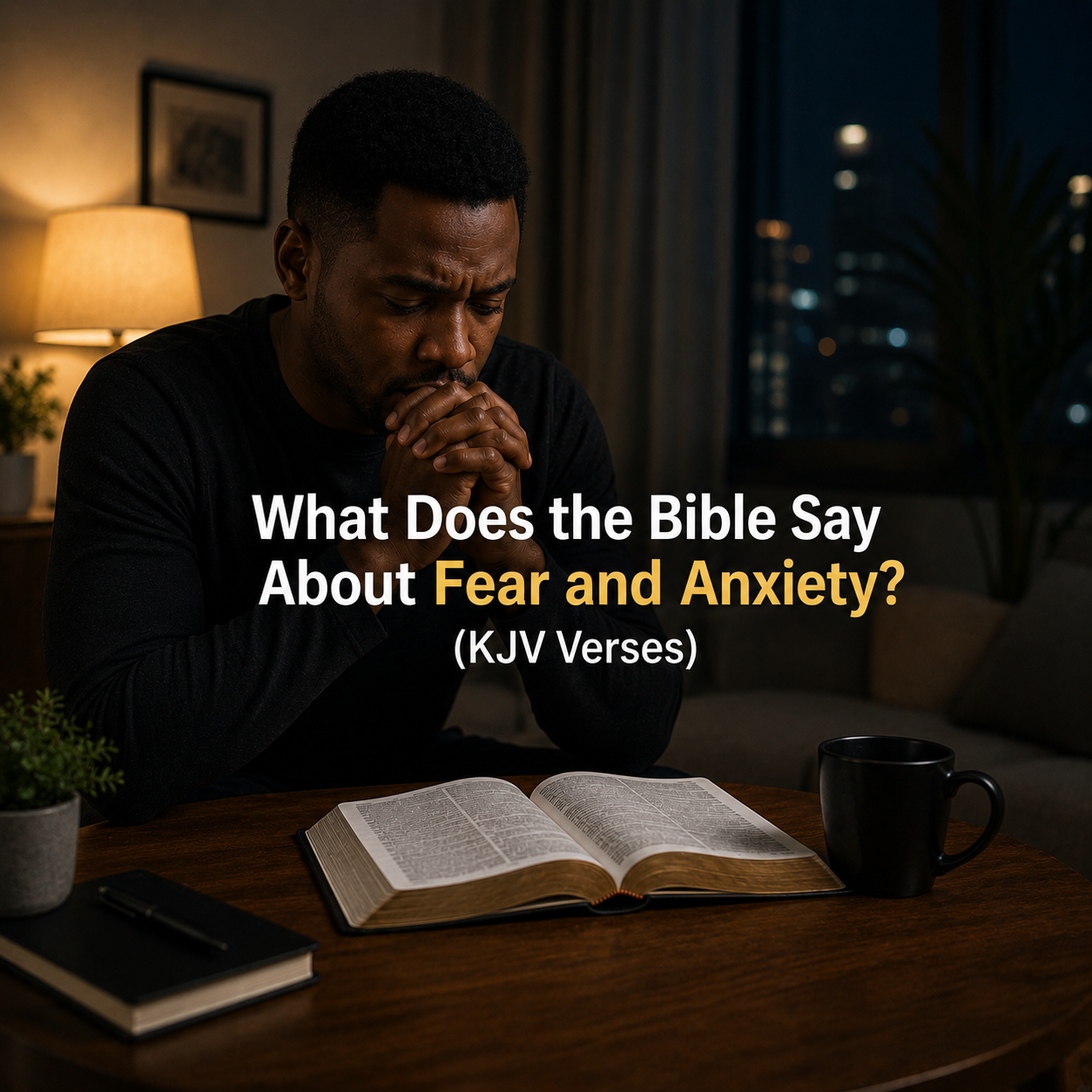
What Does the Bible Say About Fear and Anxiety? (KJV Verses)
Searching for what the Bible says about fear and anxiety in the KJV is one of the most honest things a person can do when the weight of worry has become too heavy to carry alone.
Fears and anxieties are nothing new. They are as ancient as man. David wrote about them in the Psalms. Letters of the apostle Paul speak in them. Jesus specifically taught about them in His word. Those words are imparted with a certain weight and beauty that many believers find groundings when everything else feels uncertain to them in the King James Bible.
So, this article is not going to tell you to simply pick up a bunch of verses on fear and then recite them as a mantra, it is going to be a real exploration of what scripture actually has to say on the subject of fear and what the old KJV translation actually contributes to this discussion.
Why Fear and Anxiety Are So Common Among Christians
Many believers carry around an unspoken guilt about anxiety. It is assumed that if you truly trusted God you wouldn’t fear Him. But if you had a strong faith, then anxiousness would have no resting place in you! This is an anxiety that somehow is proof of the spiritual failure.
That is not a Biblical belief. Fear is one of the characteristics of some of the most faithful in Scripture. Elijah sat under a tree and asked to die because the weight of his circumstances had become unbearable. Physically with Jesus in the boat the disciples were frightened in the storm. Paul was troubled on all sides, perplexed and cast down.
God’s response to fear and anxiety throughout Scripture is never shame. It is always an invitation. Come closer. Bring it to me. Pour it out upon me for thy sake; for I delight in thee. In the KJV, God’s attitude toward the worrying mind is always to stretch out towards it and never away from it.
What Does the Bible Say About Fear and Anxiety KJV and What It Means
To read the Bible on this level of understanding, one must spend time with the original text and content of the KJV translation, as the words used by the translator have meaning in their context which is corrupted by the shorter modern versions.
Psalm 34:4 in the KJV says I sought the LORD, and he heard me, and delivered me from all my fears.
Notice the verb. Sought. Don’t make it a passive verse; don’t passively read this one stating that fear just goes away; it’s not a verse that God just removes on his own when you are sitting around. It is a testaments of someone who was going toward God in the middle of their fear, and God was moving back. The seeking paved the way for deliverance.
It’s a significant difference. It says that the way of fear in Scripture is not the way of bravery or courage, but the way of fear itself. It is the upright, active attitude of fear towards God.
Isaiah 41:10, KJV: Fear thou not; for I am with thee: be not dismayed; for I am thy God: I will strengthen thee; yea, I will help thee; yea, I will uphold thee with the right hand of my righteousness.
There is no chance that there was repetition in that verse. The KJV maintains the emphatic nature of the original. There are three times a promise. I will uphold, I will strengthen, I will help. God is not making a suggestion. He’s making a statement.
The Difference Between Fear and Anxiety in the KJV
The one thing that is important to grasp for any serious student of this subject is that, although sometimes they are confused in modern usage, fear and anxiety are not the same in the KJV.
The KJV uses the word fear to refer to something outside, present, threatening, a person, a circumstance that is overwhelming. The word translated anxiety is sometimes anxiety, sometimes carefulness, and usually refers to the internal and continuing worry about matters that are not settled.
Matthew 6:25 in the KJV uses the word take no thought, which translates the Greek word for anxious concern, the worry that keeps circling around uncertain futures.
Jesus is not commanding His audience to be foolish or to act recklessly. He’s trying to change how people approach a possible future in some ways, from a “what do we need to do?” mindset, to an attitude of “how do we place our faith?”
The distinction is important in reality. Fear and anxiety are related and the fear of the present will require slightly different responses from the anxiety for the future. Present fear calls for the kind of direct, immediate seeking that Psalm 34 describes. The constant stress requires the continued rewiring of the muscles of trust in the way that Matthew 6 offers us.
What the KJV Brings to This Conversation That Other Translations Miss
Those individuals who were brought up with the King James Version and get the feeling that it has a weight of its own in times of fear and anxiety are often not always matched by a modern translation as exactly as they would like. This isn’t a simple throwback. It is a phenomenon that’s really there, and it needs to be recognized.
The formal register of the KJV, which uses thee and thou instead of the newer you and your, the rhythmic cadence of the sentences in the KJV (as in the first sinister’s rhyming with the second) give it a sense of gravity and permanence that the casual language of more modern translations might lack. The language which reaches you most directly is the language of your mind and heart formed by reading and memorizing the same over the years when you are in real need.
This is one of the reasons it’s incredibly valuable to Christians to memorise verses of scripture relating to fear and anxiety from the KJV. The verse that you memorized from the language of your heart is the one that will surfaces when you need it most at three in the morning.
How to Actually Use These Verses When Fear Arrives
If you know what the Bible says about fear and anxiety, then that’s really good. However, a difference between understanding a verse and having a verse to help you at a time of crisis is a difference that many people’s devotional readings will not do justice to showing in an honest way.
There are Bible verses to say why you don’t need to fear, but why they rarely help you in times of actual fear is because the message itself is not false, but rather the underlying point. When you recite a verse at your fear but don’t pray in the heart, it’s not a real encounter with God; it’s a way of coping.
It’s better to begin by asking a question than end with a question. Take the language of Psalm 34:4 and make it personal. Lord, I am seeking You right now. I am very frightened of this particular thing. Hear me in this. The verse isn’t the entry-key to prayer, it’s the key, but only if you put it in.It is not magic words to pray, it is key to prayer if you put it in the door.
That kind of use of Scripture in the middle of fear and anxiety is what produces the peace that Paul describes in Philippians 4:7, a peace that passeth all understanding. It is not the knowledge of good words that brings it. It’s the experience of facing the God that the words are pointing to.
Frequently Asked Questions
Q1. Are there KJV verses specifically about anxiety attacks or panic?
The KJV does not use the clinical term ‘anxiety attack’, but in Psalms 55 and 69 there are reference to ‘overwhelming distress’, ‘racing thoughts’, and a desperate appeal to God, these all are aligned with what we would today call a panic attack.
Q2. Is it wrong for a Christian to be anxious?
No, not being in a state of anxiety is NOT the same thing as sin, and neither is being in a state of pain. Keeping your anxiety is not a moral sin. What Scripture calls for is bringing this experience to God instead of allowing it, without reference to God, to make choices and be the basis of thinking. This invitation is not a condemnatory, but it is a relational one.
Q3. Which kJV verses will be the most helpful when praying through fear at night?
One of the most direct citations to nightly fear is in Psalm 4:8, in the KJV: “I shall both lie down and sleep; for thou, LORD, only makest me dwell in safety. Psalm 91, with its imagery of dwelling in the secret place of the most High, is another passage that many believers find grounding specifically at night when fear tends to feel most immediate.
Q4. What verses are helpful for someone who is afraid?
Kids appreciate verses that are concrete rather than abstract. Images of God as a shepherd, a sturdy tower, sleepless, non-sleeping, are more accessible to young minds’ imagination when compared with images of transcendent peace. Read the verse together, ask them what picture comes to their mind, and let the conversation follow the picture, don’t immediately explain away the fear.
Q5. Does reading the Bible cause anxiety?
It can for some in certain circumstances. Without a pastoral context and without balancing passages about grace and mercy, passages on judgment, or trials or consequences of sin, may heighten, not lessen, an anxious person’s anxieties.
Q6. What’s the difference between the two types of “fear” in the KJV (Godly and anxious)?
The word fear can mask two very different uses of the word by the KJV. Godly fear is a humble awareness of God’s holiness and power that leads to wisdom, humility and trust. Anxious fear is fear to an unknown threat or uncertainty that leaves them in a state of tension, avoidance and distress.
Conclusion
Knowing what the Bible says about fear and anxiety in the KJV is not primarily an intellectual exercise. It is a resource for real moments of real distress, and the KJV language carries those resources in a form that many believers find particularly close to the bone.
God’s posture toward your fear has never been impatience or disappointment. It has always been an open invitation to bring what you are carrying to the One who can actually bear it. The verses are there. The door is open. And the God on the other side of that door is not surprised by what you bring.


very cool
Nwamaka Ezennaya
Thank you
I am happy
Fear is the greatest weapon that the devil uses to destroy the children of God
The fear of God is the ultimate