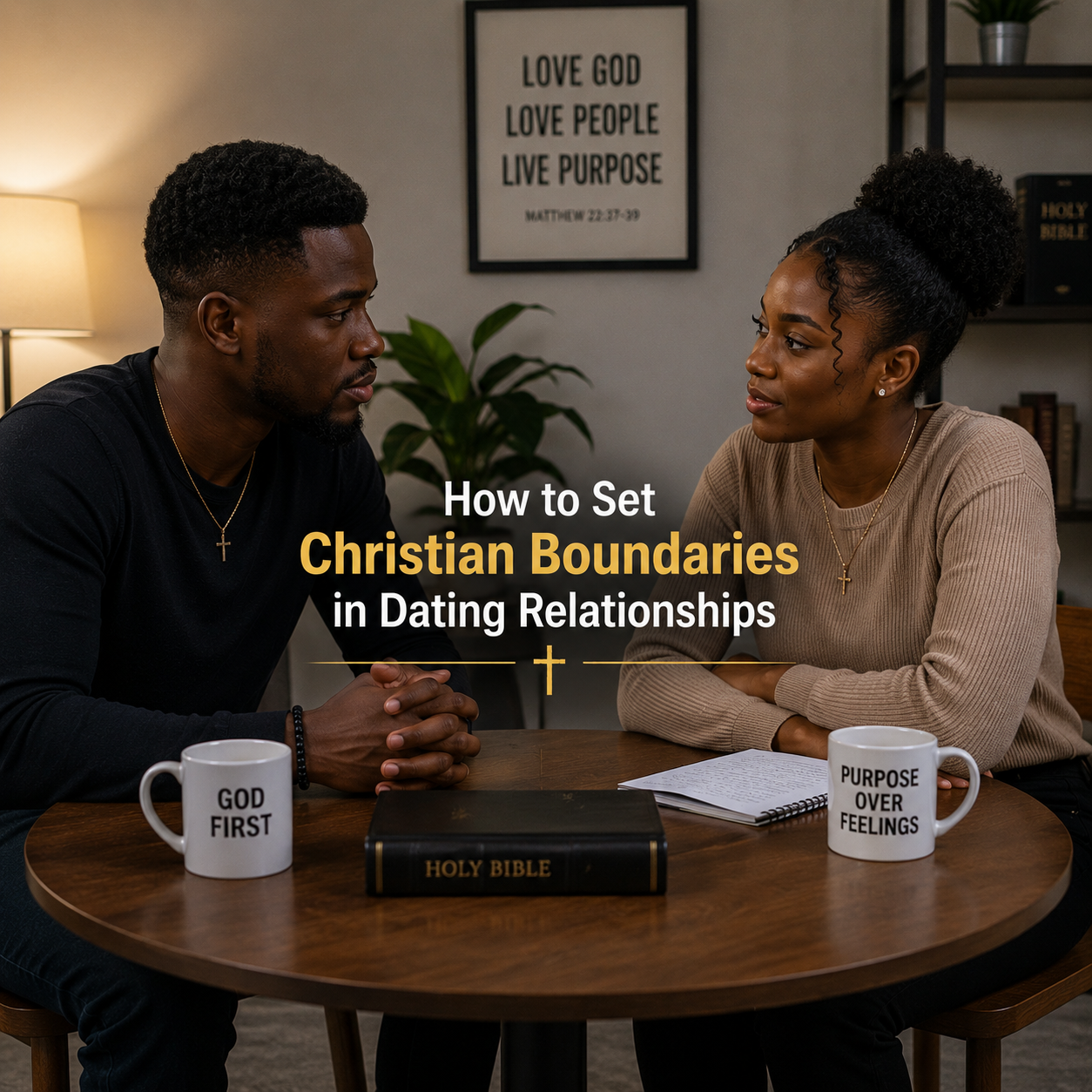
How to Set Christian Boundaries in Dating Relationships
Setting Christian boundaries in dating relationships is something most believers know they should do and far fewer actually know how to do well, which is why so many sincere Christians end up in situations they genuinely did not intend to be in.
It’s not typically a shortage of values. It has to do with an inability to think practically. You may have strong beliefs about purity, but you might be in a relationship with a person where those beliefs are challenged on every interaction you have with them, because no one ever explained to you how to structure a relationship that allows you to live out those beliefs in a way that’s really sustainable.
In this article I am going to be practical and truthful. Not practical or shameful, but helpful to someone wanting to know how to do it in the middle of a real relationship with a real person they care about.
Why Christian Boundaries in Dating Relationships Are So Hard to Keep
Christian boundaries in dating relationships are more difficult to maintain than most people realize is not primarily a willpower issue. It’s a design dilemma.
God created people to be deeply connected. Emotional bonding happens when physical closeness is activated. Over time, emotional bonding gives the impression of more and more arbitrary boundaries. That is not a flaw in your character. It’s your nature. Knowing that to work with it, you must first understand how to wire it.
If there is no deliberate structure to the relationships, they tend to fall apart. Not because either person is wrong, but because when physical and emotional intimacy happen it generates its own momentum, in a certain direction, if not being deliberately directed. It’s not the couple that has more willpower than the rest who is the one who navigates this well. They are the ones that put structure into their relationship before the momentum had begun, not instill structure into their relationship after it had begun.
What Biblical Boundaries Actually Are
Before talking about how to set them, it is worth being clear about what boundaries in this context actually are. A boundary is not something that is imposed on you by someone else, and that you feel obliged to accept. A conscious choice: a choice you make, a choice you know you made, a choice that you feel good about making.
It makes all the difference in the world, as it is a boundary that you own, you will maintain. One rule that you’re doing because you don’t want to or feel like you should will fall apart when you get emotionally attached to it and the rule is not relevant.
The Biblical boundaries of dating are founded on a particular theological perspective. Your physical body and your emotional state are not distinct from your spiritual state. What you do with your body affects your relationship with God. Affects your wellbeing, and that of those you are close to, through what you do with your heart and how you emotionally connect with them. A boundary is where you proactively protect everything that you have instead.
1 Corinthians 6:19 in the KJV says What? know ye not that your body is the temple of the Holy Ghost which is in you.
This wasn’t meant to elicit guilt for anyone. One that elicits dignity. Your body belongs to something sacred. You tell yourself a lot about it by how you draw the lines.
How to Actually Set Christian Boundaries in Dating
The best time to establish limits in a relationship before you require them. Sure, the obvious time to set a clear boundary is when it becomes uncomfortable, but most couples don’t do so at that time.
Have the Conversation Early and Honestly
At the beginning of a new relationship, when physical and emotional attraction has not developed enough to start to get in the way, both are best able to consider their relationship goals. Talking about values, about what is comfortable for both of them, about what limits to draw is respect for each other, not such an awkward formality.
It doesn’t have to be a formal negotiation in a seated environment. It can be a healthy attraction to asking questions of a potential partner. What do you believe about physical boundaries in a relationship? What is important to you regarding our physical and emotional connection? When asked with a sincere heart, those questions begin a conversation that will keep both safe.
Be Specific, Not Vague
The boundary “Do not have sex with people who are not your spouse” is not a boundary. It is a value statement. A boundary is the definition of what this would be in practice. What scenarios you will steer clear of? What should you do if it’s a toxic relationship? Where do you two agree to back off? What will your accountability systems be?
General values break down at the pressures applied. Specific agreements occur because both parties are aware of what they agreed to and why.
Make Your Decisions Outside the Moment
One of the most useful dating boundaries tips is to decide on a position before the situation comes to test it. When you learn to keep your emotions under control you can think clearly. When it comes to clear thinking, it’s when you’re in the presence of someone you care about with emotional involvement that you’re at your lowest ebb.
This is not a reflection on either your faith or your character. It’s a manner in which human beings are made. Rigidity is not making decisions ahead of time, and then making them in the moment. It is wisdom.
Build in Accountability
Healthy and balanced Christian dating relationships typically have accountability as a feature. This means that there’s at least one or two people outside the relationship who know both of you, who know what you’ve committed to doing, and who have the relational authority to ask some honest questions.
Accountability is not surveillance. It is a safety net. It brings to a relationship a sense of knowing that the relationship is not just you and me, but others care about you and me, and the decisions you make as a couple are not made to be just yours and mine.
The Emotional Boundaries That Christians Often Overlook
Most Christian content on dating boundaries focuses on physical limits, and those matter. Emotional boundaries are equally critical and less talked about.
Emotional intimacy and depth of self-disclosure, levels of dependency and the extent to which one becomes the other’s chief emotional support system, can progress ahead of sexual intimacy and can form an equally complex bond if the relationship fails to endure.
Proverbs 4:23 says Keep thy heart with all diligence; for out of it are the issues of life.
The heart in this sense is not only the source of emotion. It’s the point of your inner life, your will, your wishes, your deepest engagements. In dating, guarding your heart means being careful about what you give to the person you are dating until you have some commitment and history with them.
It’s not to the detriment of emotional unavailability. It involves balancing the depth of emotional sharing based on the depth of commitment in the relationship. When you open up to someone you’ve been together with for only three weeks, you’re exposing your deepest vulnerabilities to someone who may not be able to handle it.
What to Do When a Boundary Gets Crossed
It is not a perfect process to keep boundaries when it’s a real relationship with real feelings. Boundaries get crossed. Commitments get tested. In any relationship, there are times of compromise.
What is important is the answer to the crossed boundary. Some couples consider the crossed boundary as a cue to reassess and reconnect. Others allow it to be a doorway, and when they step through, they feel that they have to step through again. Those two responses are typically accompanied by the absence or presence of honest conversation afterward.
Together, saying no when we weren’t prepared to say yes is a way we can be honest, not shameful or blameful, and in a way that sustains a relationship instead of harming it. The couples that create true integrity in their dating relationships are not the ones who never make mistakes. It is they who are honest and continue to make wrong choices and get back on track with their commitments.
Frequently Asked Questions
Q1. Does both partners of the relationship have to be on the same page regarding the boundaries?
Yes, and that will not change on a practical basis. If only one person is interested in a boundary, it is not a shared boundary. One person is trying to keep a line, and the other one is regularly checking it.
Q2. Should we tell our parents or pastor about the boundaries we have set?
It is not required to share all details, but it’s helpful to have at least one trusted adult who understands your relationship and the plan you both have. Another person you are familiar with and respect, like a pastor or a married couple, can bring insight you don’t have at this phase in your life. Their involvement doesn’t need to be continuous surveillance.
Q3. If my dating partner is not a believer and doesn’t know the significance of these boundaries, what am I to do?
The challenge isn’t simply that your partner doesn’t understand the boundaries as it is that they simply don’t believe in them. In other words, the whole system in the boundaries is outside the system they need to function in.
Q4. Can you establish boundaries in the early stages of a relationship when there aren’t any boundaries?
Yes, and even if that is uncomfortable. If you’re just talking about what you want your relationship to be and you’re honest about your thoughts, then I’m not rejecting the relationship. It is an investment that is made in it.
Q5. What is the difference between physical and emotional “boundaries” for Christians dating?
Physical boundaries regulate physical contact and affection. Emotional boundaries are described by the level and rate of emotional revealing and reliance.
Conclusion
Setting Christian boundaries in dating relationships is not about following rules for their own sake. That’s a relationship based on respect, honesty and shared values that will benefit both of you well after the initial spark of attraction fades.
The couples who claim real peace at the end of their dating season are the ones who took Christian boundaries in dating seriously, had the difficult conversations early, had real accountability, and took the time to protect each other intentionally and not rely on chance.
Such a deliberate approach isn’t limiting. It is one of the most affectionate things two people can do for each other before taking the marriage vows.



Will try and build my prayer life
For this article I learned a lot about the meaning of bad dreams and also the importance of night prayer
I really appreciate this article
I think Iearn a lot
I get more clarification about bad dreams
God is faithful to his people
Thank you Jesus for your protection
Prayers is the key
A beautiful piece
This is an awe-inspiring research
This is most important things that most people do not have an idea and if I may say this is amazing message to me
A very good story, and it teaches alot of good things like what should be done and what should not be done
Love is a beautiful thing
Fabiyistephen941@gmail.com
Christian’s should not involve themselves in the worldly things
Love is a beautiful thing when ur with the right person
Prayer is the key