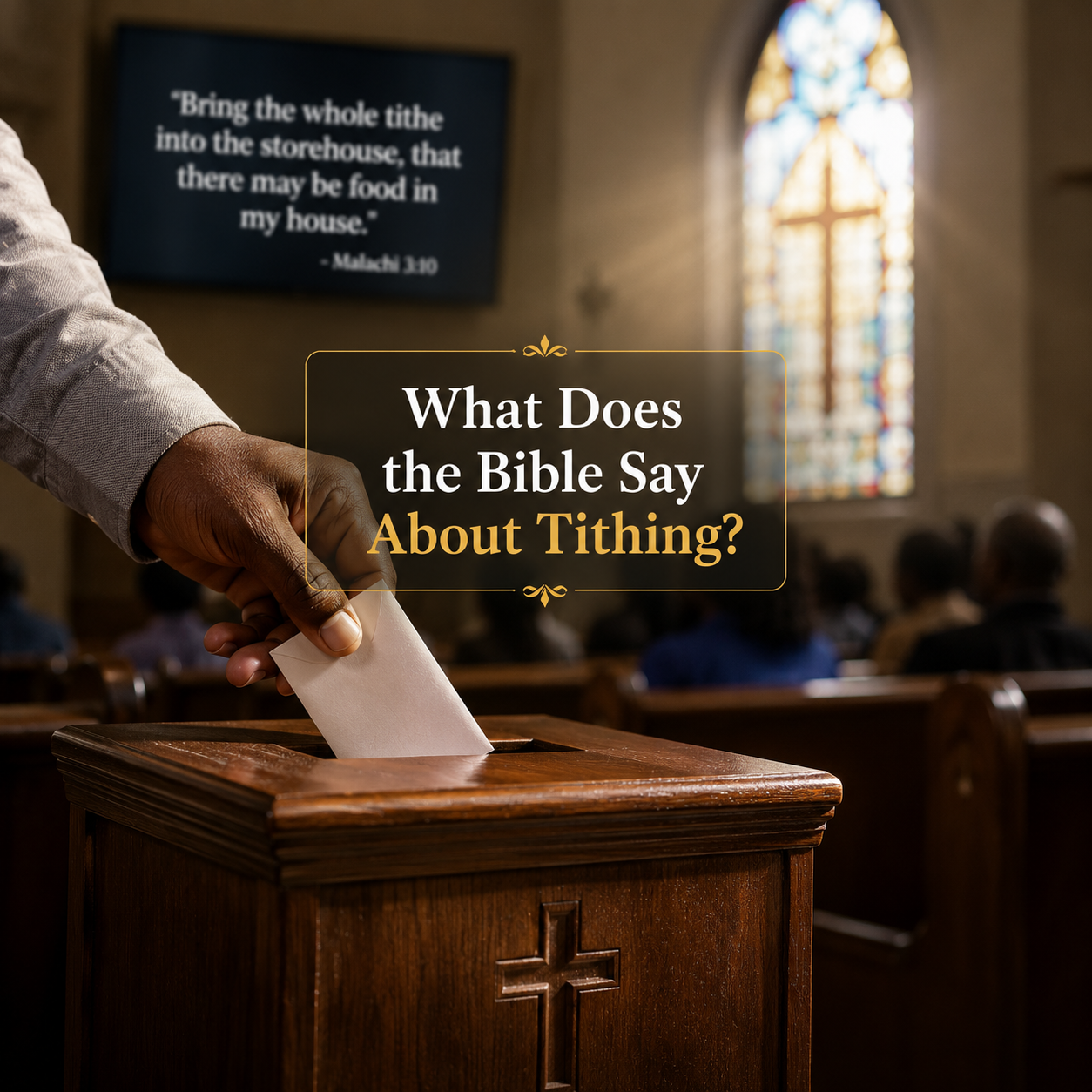
What Does the Bible Say About Tithing?
Few topics in the church produce as much confusion, defensiveness, and in some cases genuine manipulation as the question of what the Bible says about tithing, and that confusion is worth addressing with both honesty and care.
Some Christians tithe out of genuine faith and genuine generosity and find it to be one of the most spiritually freeing practices in their lives. Others tithe out of fear, convinced that not giving the right amount will result in a cursed financial life. Others have stopped tithing entirely after experiencing what felt like spiritual pressure or financial manipulation from church leaders. And many more sit somewhere in between, genuinely wanting to be obedient to God with their money but not entirely sure what the Bible actually says.
This article is going to be honest about all of it. What the Bible says, where the debates are, and what a genuinely free and generous posture toward giving actually looks like.
The Old Testament Foundation of What the Bible Says About Tithing
The biblical teaching on tithing begins in the Old Testament, where the tithe was a specific, legal requirement for the people of Israel.
The tithe, which means a tenth, was commanded in the Mosaic law as part of the covenant structure of Israel. It supported the Levites who served in the temple and had no land inheritance of their own, funded the community feasts and celebrations that were part of Israel’s corporate worship life, and provided for the poor and the stranger in the land on a rotating cycle. Malachi 3:10, the passage most frequently quoted in tithing sermons, is God’s rebuke to Israel for robbing Him by withholding the tithes and offerings that were their covenant obligation.
Understanding the Old Testament context matters for evaluating what the Bible says about tithing in the New Testament. The tithe in Israel was not simply a church offering. It was the equivalent of a tax system that funded the entire religious and social welfare infrastructure of the nation.
What Does the Bible Say About Tithing in the New Testament
Here is where honest engagement with what the Bible says about tithing requires acknowledging something that most tithing sermons do not say.
The New Testament never explicitly commands the tithe as a binding obligation on Christians. Jesus mentioned tithing twice, both times in the context of correcting Pharisees who were meticulous about giving a tenth of their herbs while neglecting justice, mercy, and faithfulness. He did not abolish the tithe, but He also did not establish it as the foundational giving principle of the new covenant.
What the New Testament does establish is a principle of generous, cheerful, proportional giving that is motivated by love rather than by law. 2 Corinthians 9:7 says each of you should give what you have decided in your heart to give, not reluctantly or under compulsion, for God loves a cheerful giver. That verse is describing something qualitatively different from a legal obligation. It is describing a heart posture toward generosity that flows from genuine gratitude rather than from compliance.
This is the tension at the heart of what the Bible says about tithing. The Old Testament establishes a specific, legal standard. The New Testament establishes a spirit of generosity that may well exceed ten percent for many believers while being genuinely inaccessible to others who are in genuine financial hardship.
What Honest Giving Looks Like Across Christian Traditions
Across Christian traditions, the approach to giving reflects genuine theological differences as much as practical ones.
In many Pentecostal and charismatic traditions, the tithe is taught as a binding covenant obligation under the Abrahamic covenant rather than the Mosaic one, with Malachi 3:10 as the key text for the promise of blessing that follows faithfulness in giving. In these traditions, tithing is treated as the entry point for financial obedience and the foundation for all other giving.
In Anglican, Catholic, and many Evangelical traditions, the emphasis tends to fall more on the spirit of generosity described in 2 Corinthians 9 than on a specific percentage. Giving in these traditions is framed more as a spiritual discipline and an act of worship than as a covenant mechanism for financial blessing. Both approaches are drawing on real dimensions of what the Bible says about tithing and giving. The difference tends to be in which dimension is emphasized.
What About the Financial Blessing Promises
Malachi 3:10 does include a promise of blessing in response to tithing, and that promise is real. But it deserves careful handling.
The promise was made to a specific community in a specific covenant context, and treating it as a universal financial formula that guarantees wealth in response to giving is an overextension of what the text supports. Many faithful, generous Christians have given consistently and not become wealthy. Many people in contexts of genuine poverty give sacrificially and remain financially constrained. Framing giving primarily as an investment strategy rather than as an act of worship tends to distort the spiritual meaning of the practice.
What does hold consistently across Scripture is that generous giving produces spiritual fruit. It loosens the grip of money on the heart. It builds trust in God’s provision. It expresses genuine worship. And it tends to produce a quality of financial peace that has nothing to do with the amount in a bank account and everything to do with the posture of a heart genuinely submitted to God with its resources.
Frequently Asked Questions
Q1. Should I tithe on my gross or net income?
The Bible does not address this specific question because the ancient economy did not have income tax withholding.
Q2. Should I tithe if I am in serious debt?
This is a pastoral question that deserves honest engagement rather than a formulaic answer. Some Christians believe tithing should remain a non-negotiable regardless of financial circumstances. Others believe that wisdom sometimes calls for addressing serious financial crises before restoring a tithe.
Q3. Can I tithe to organizations other than my local church?
Theological positions on this vary. Many traditions hold that the tithe specifically belongs to the local church, the storehouse of Malachi 3:10, with additional giving going to other ministries and causes.
Q4. What do I do if I feel my church is misusing tithes?
This is a real and serious concern that deserves honest attention. Transparency and accountability in church finances is a genuine biblical value. If you have serious concerns about financial integrity in your church, raising them directly with leadership, seeking the counsel of trusted believers, and prayerfully considering whether that church is the right home for your giving are all appropriate responses.
Q5. Is there a connection between tithing and financial breakthrough?
The connection described in Malachi 3:10 is real and the testimony of many believers supports a lived experience of God’s faithfulness in response to generous giving.
Conclusion
Understanding what the Bible says about tithing with honesty produces neither fear-based compliance nor dismissive avoidance.
The full picture of what the Bible says about tithing is an invitation to a generous, free, worshipful relationship with your resources that reflects genuine trust in a God who owns everything and who cares about the posture of your heart far more than the calculation of your percentage.
Give generously. Give cheerfully. Give as an act of worship rather than an act of compliance. That is where the real freedom is.






Wonderful article 🥰
Yeah giving should be generously
This is amazing The full picture of what the Bible says about tithing is an invitation to a generous, free, worshipful relationship with your resources that reflects genuine trust in a God who owns everything and who cares about the posture of your heart far more than the calculation of your percentage.
I really love this
I really love this so so wonderful
The full picture of what the Bible says about tithing is an invitation to a generous, free, worshipful relationship with your resources that reflects genuine trust in a God who owns everything and who cares about the posture of your heart far more than the calculation of your percentage.That’s all I lovey about it so beautiful
This is so amazing wow wow wow so beautiful
God is good
It simplify means give to elevate your finsncial life
Nice
i love this article.
God bless the writer
Be generous
Nice
In all you do in this life make sure you accept Jesus Christ as your lord and personal Savior
*”God isn’t after our percentage. He’s after our heart. Cheerful giving isn’t legalism and it isn’t avoidance either — it’s trust. And that’s where joy lives.”*