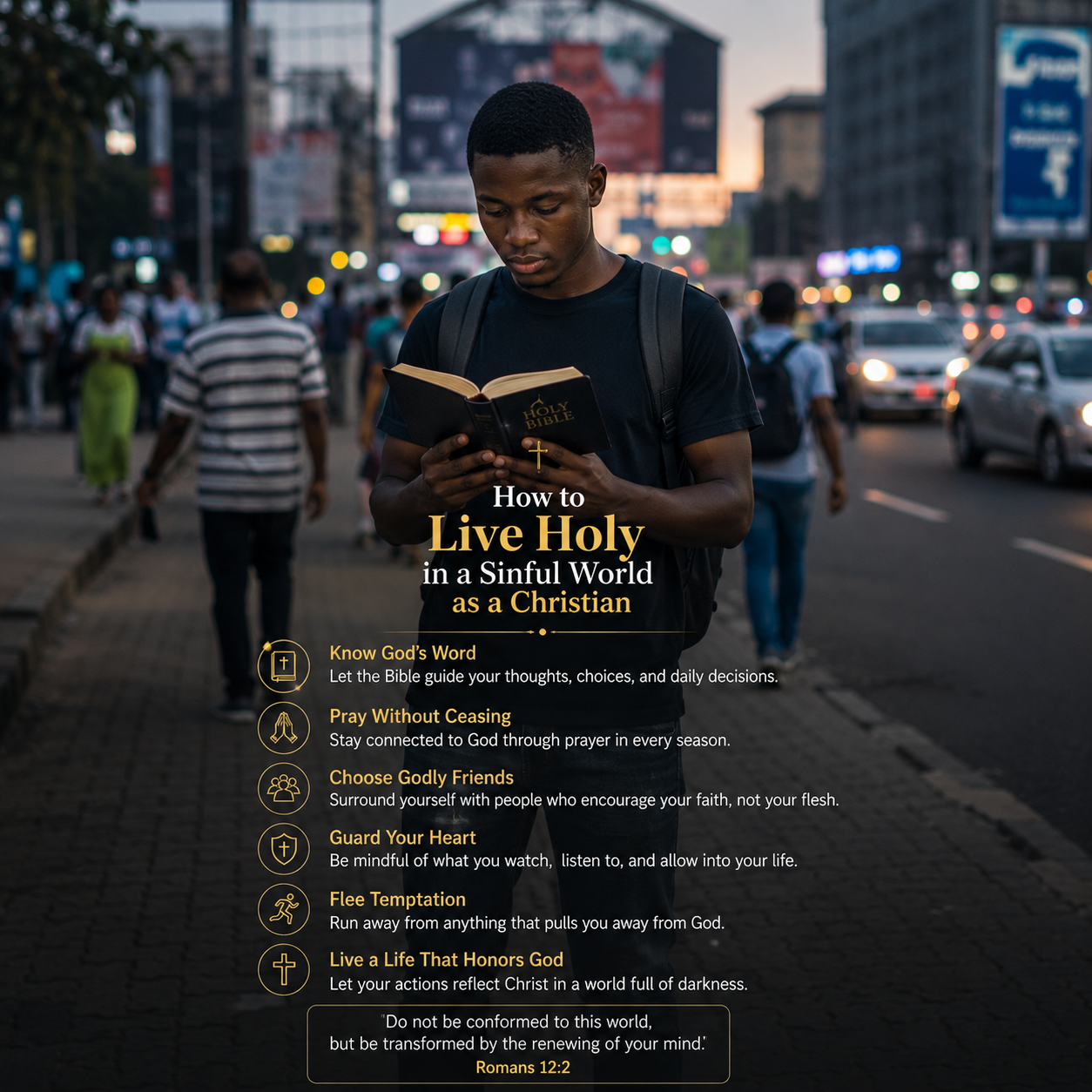
How to Live Holy in a Sinful World as a Christian
Figuring out how to live holy in a sinful world is one of those questions that every serious Christian eventually sits with, and it seems less easy in practice than it does in theory.
Well, in theory, holiness is easy to understand. Avoid sin. Pursue God. Do things differently to the culture around you. However, Monday comes and goes. Your coworker makes a statement that would make compromising easier than conflict. Your phone algorithm continues to deliver material that tugs at parts of you that you would like to leave out. Those you love most are doing things that go against all that you value, and it seems like it is hard to do so without losing the person and without losing your integrity.
This article will never claim that holiness is easy. It’s going to take seriously the real complexity of living a holy life in the middle of a world that is not holy; it’s going to provide something more helpful instead of a list of things to avoid.
What Holiness Actually Means and Why Most People Get It Wrong
Most Christians are carrying an incomplete concept of holiness, and complete holiness is a burden that’s heavier than ought to be.
For the popular Christian mind, holiness is principally one of separation. It involves refraining from doing some things, going to some places, being around some people or content. This picture isn’t a complete lie. But it’s only half the truth, and those who know just the avoidance half often end up with an overly fatigued, jaded and brittle form of faith.
Holiness of God is not simply taking things out! It is the change that you are going for. In Scripture the word holy is used to mean for a special purpose. The purification of a vessel is not enough to make it holy, it must be consecrated and dedicated to a specific use. Holiness isn’t so much a matter of not being dirty as it is a matter of being dedicated.
The seeking of holiness becomes a different kind of feast when it’s viewed as a way to be devoted instead of merely not doing. You don’t need to stay clean primarily. Your main focus is to remain in God. But it is not proximity to sin that brings about the change, it is proximity to God that brings about the change, that is what actually brings about the change that avoidance never really brings about.
The Real Challenge of Living Holy in a Sinful World
In this context the term sinful world is worth considering in a self-honest way, because most Christians tend to use it when they speak about culture, the media, people’s attitudes, etc., but not when they are called into question.
In fact, the sinful world is within you. For most believers it is the more immediate frontier of holiness, the patterns of thinking, the default impulses, the deeply ingrained habits of heart, formed before the faith and still evident after it.
It is not a ‘despair’ session. The diagnosis is correct. And precise diagnosis results in better treatment than imprecise diagnosis.
If a Christian is trying to get rid of external temptations when neglecting their inner person, they are battling on the wrong side. Fellowship with God is the thing that makes the difference in becoming a holy person; a holy thought, a habit of thinking in the right way, a thought that God loves, a thought that God cherishes, a thought that God desires – a holy thought in the mind, a thought that God has blessed – an idea that God has embraced is what makes the difference.
How to Live Holy in a Sinful World Through the Inner Life
The most important arena for anyone learning how to live holy in a sinful world is not their behavior. It is their spiritual life. Consistent habits over time form the inner life more than do dramatic moments of spiritual intensity.
The Practice of Renewing Your Mind
Romans 12:2 describes the mechanism of spiritual transformation as the renewing of the mind. Not cleaning the behavior, per se. Not the enhancement of the performance. Renewing of the mind.
What this means in practice is to develop practices that regularly touch your thinking to God’s thinking. This is most directly realised in regular Scripture reading. Not reading as a spiritual obligation to check off but reading as a practice of allowing God’s way of seeing things to push back against the thousand other ways of seeing things that the world offers you every day.
It’s not about memorising information. It is to have one’s default thinking patterns, one’s default emotional responses, one’s default interpretation of what is happening around you that are progressively refformed instead of refinded by what is loud, rather than what is true.
Prayer as Orientation, Not Transaction
Perhaps the biggest change in the life of a Christian towards holiness is to move away from the mentality of prayer as a tool for asking from prayer as an orientation practice.
Prayer that only asks leaves you spiritually thin. That kind of prayer creates that kind of inner stability, the sort of stability that holiness needs: stillness, honest recognition of your state, listening for God’s response and thanking God for what is already true.
If someone is truly growing in this type of prayer life, he or she is not avoiding the temptation in particular moments. They find that the texture of their entire interior life begins to change. Things that used to be irresistible become not so irresistible anymore. It’s not a matter of the temptations going away, but the inner sanctuary has changed.
Fasting as Spiritual Discipline
Fasting is one of the most neglected means to holiness in the modern Christian life and one of the most strongly recommended throughout the Bible.
It is not a physical thing. This controls the passions and the body for the spirit instead of the spirit for the passions and the body. A person who regularly practices fasting is building a kind of volitional muscle that extends beyond the fast itself. They are learning that not all desires have to be fully met, and they are learning that way in a tangible and physical way. The practice does have real consequences at the level of desire in all other aspects of life.
See RCCG Fasting Prayer Points for 100 Days
Living Holy in Relationships Without Withdrawing From the World
One of the most common misapplications of the call to holiness is the idea that living holy in a sinful world means creating maximum distance from anyone or anything that is not explicitly Christian.
In its theological aspect that is a problem. Jesus did not isolate Himself from the crowds that surrounded Him that lived lives that were apart from His values. He approached them in a way that was both loving and upright, and He went without a single compromise, neither in his own love, nor in His integrity. He was in the world, but in reality, he was not in the world—this wasn’t because of distance, but because of the difference between us and him. It was a matter of the direction of His heart.
One can have true friendships with those who are not of the same faith. You can be active in non-christian environments and lives and dialogue with non-christian people. The call to holiness does not mean that you have to leave those places. It requires you to inhabit them with a consistent integrity that is actually more influential than any amount of deliberate withdrawal.
1 Peter 2:12 puts this well. It calls believers to live such good lives among people who do not share their faith that those people may observe their good deeds and come to recognize God. It’s not a sign of separation. It calls into the body a quality of life that is palpable and real, not just because it is lived in the midst of real engagement with the world, but because it is lived in it.
Frequently Asked Questions
Q1. Is it possible to live a truly holy life in today’s world?
Yes, but the holiness that can be achieved is a different one from what many Christians have in their imaginations. It’s not a condition of sinless perfection. It is an authentic and constant turning to God that affects both your choices and your relationships and even your personal life in observable ways.
Q2. As a Christian who desires to live a holy life, how do I manage my entertainment and media?
This is one of the most practically debated issues about holiness in today’s world. The most useful approach is not to make a list of approved and disapproved content, rather, it is a simple analysis of how certain content impacts the inner life. Some content raises you up to a higher spiritual state than you were in prior to consuming it.
Q3. What should I do when I feel like I am not making progress in holiness?
First, if you’re measuring progress by the wrong things. But if you measure by the absence of temptation, as well as by a felt sense of spiritual intensity, you will probably be disappointed, since either of these is not a correct measure of true transformation.
Q4. How do I respond to relatives who say that my desire for holiness is too much?
With patience, consistency, and a genuine lack of superiority. When you think that you’re setting the standard for everyone else to turn to, there’s nothing that will close the eyes of your family members quicker than that.
Q5. Is there such a thing as being holy outside of a church community?
They can make an effort, but it is much more difficult and much more lonely. For all the imperfections in it, the church supplies exactly what the self-made pursuit of holiness is often missing: a community, accountability, challenge, and encouragement that are always there.
Conclusion
The answer to the question of “how to live holy in a sinful world” is not a tidy and finished one, and is not a one-size-fits-all. Holiness is not a completion or a finished product, but a process. It’s a path you constantly follow, a relationship you continually care for, a life day by day starts to build.
Living holy in a sinful world involves learning that both the world in which you live and the world in which you find yourself is being lived by God, and that it is being inhabited by both.
It means building habits that keep you close to Him. It’s letting go of yourself the grace the way you are learning to let go and receive from Him. It also requires us to have faith that the God who started a good work in us is working on it and will bring it to completion, even on the days we do not see any results.




Figuring out how to live holy in a sinful world is one of those questions that every serious Christian eventually sits with, and it seems less easy in pra
Life is all about exploring and observing