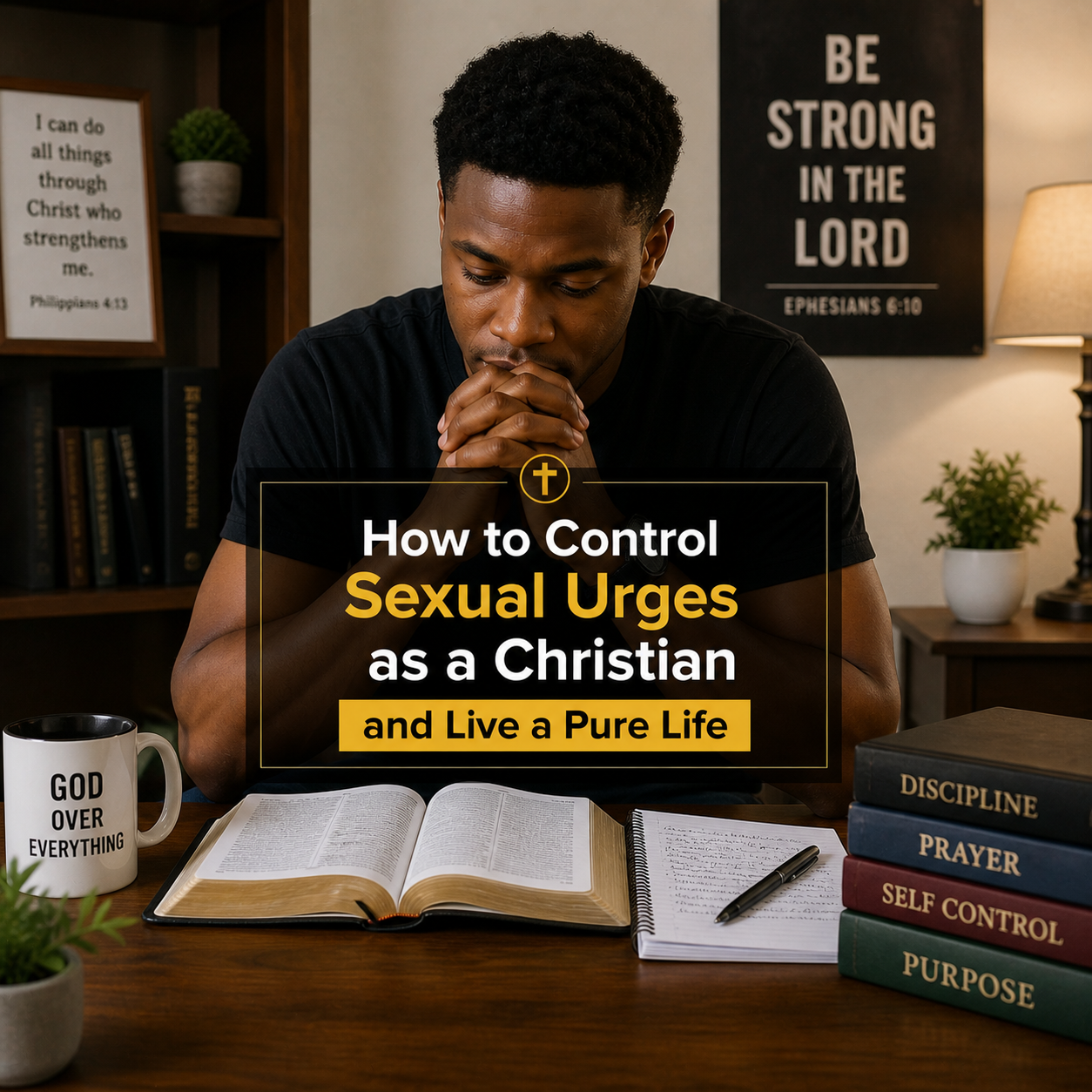
How to Control Sexual Urges as a Christian and Live a Pure Life
Figuring out how to control sexual urges as a Christian is one of the most honest and courageous questions a believer can ask, and the fact that most churches avoid it directly is part of why so many sincere Christians feel alone in the struggle.
The silence from the pulpit does not mean the struggle does not exist. It means it goes underground. And things that go underground tend to grow more powerful in the dark.
This article is not going to give you a shame spiral or a list of rules that ignores how real temptation actually works. What it will give you is a grounded, honest, faith-rooted understanding of what is happening when you struggle in this area and what actually helps people walk in genuine freedom.
Why This Struggle Does Not Mean You Are a Bad Christian
The first thing worth saying is that experiencing sexual urges is not sinful. That distinction matters enormously and gets lost in a lot of Christian conversations about purity.
Sexual desire is part of how God designed human beings. It is the response to that desire that carries moral weight. A Christian who feels temptation and turns to God in the middle of it is doing something spiritually significant. A Christian who feels temptation and pretends it does not exist is setting themselves up for a much harder fall.
The struggle itself is not your failure. It is your humanity. And God is not surprised by it.
What changes things is not the absence of temptation. It is what you build into your life so that temptation does not get to make decisions on your behalf.
Understanding Why the Urge Feels So Powerful
This is one thing that can help a great deal when one realizes what is really going on when one is subjected to a very strong temptation. It is perceived by most people as the thing that comes out of the blue and engulfs the person before he or she can even do something about this. That experience is true and at the same time it is misleading to a small extent.
Temptation almost never comes from nowhere. It is prone to appear under foreseeable circumstances. Your resistance is reduced and the attraction given off to things that provide an immediate comfort or an escape. That is not a moral failing. This is just simple human psychology.
When you begin to chart the circumstances in which you find yourself at your worst, you will acquire something quite useful. You can learn to combat the conditions and not merely trying to fight the temptation after it has already reached full strength.
An individual who never makes an effort to address the trends that lead to such situations, but instead simply engages in the same fight over and over again, will burn themselves out. An individual who commences combating the conditions does the struggle upstream, a far more winnable front.
How to Control Sexual Urges as a Christian Through the Mind
No weapon is as strong as the mind of a person learning to control sexual urges as a Christian. It will not be will power in the crude sense, but the vigorous rejuvenation of your thinking.
Romans 12:2 says to be transformed by the renewing of your mind. It is not the ornamental word. It is a rather practical teaching. What you always feed your mind with, determines what your mind reacts to when under pressure. When a person continually stuffs his/her mind with Scripture, with worship, and with spiritually grounding material, he/she creates a mental environment in which temptation is not given so much room to rule.
This does not mean spiritual content replaces everything else in your life. It is about having thought about what is taken up in your mental space at idle times because it is at idle times that temptation is more prone to move into your mental space.
Some real-life applications of this are switching idle scrolling with a podcast, audiobook, and music used in worship services. Going out when one feels restless instead of going to the screen. And having a sermon or passage in the Bible, which you refer to when you find yourself drifting off in a direction that you do not wish to.
All these are not magic. They are habits. And habits, which are gradually acquired through time, switch the default condition of your internal life.
The Role of Accountability in Walking in Purity
Accountability is one of the things that distinguish between Christians who find true freedom in this aspect and those who spend years of their life in the same cycle. Not shame-based confession to someone who makes you feel worse. True, honest responsibility to someone you can trust and who is knowledgeable about what you are dealing with, and genuinely cares about whether or not you are actually free.
This is not very pleasant to begin with. It is long resisted by most people. The thought of informing another human about the very ways in which you are a failure is embarrassing. But here is what people who have done it consistently report: the temptation loses a significant amount of its power the moment it is named out loud to another person.
Something about the clandestine battles feeds on their own secret. Taking them out in the sun does not remove the battle at night. But it undermines one of the important components of what makes the struggle so daunting and so lonely.
An accountability relationship is most effective when it is guided by true care and not judgement, when it involves frequent check-ins as opposed to just during moments of crisis and when in the relationship both parties understand that they are in it to the long haul and not to seek short term fixes.
What the Body Needs That People Rarely Talk About
Here is something that almost no Christian content on this subject addresses directly, and it is genuinely useful.
Physical health has a direct relationship to how manageable temptation feels. Sleep deprivation, poor nutrition, and a consistently sedentary lifestyle all lower the threshold at which temptation becomes overwhelming. This is not speculation. It is consistent with what believers who have worked through this struggle report from experience.
Exercise, in particular, has a measurable effect on the body’s stress and reward systems. It provides a genuine physical outlet for restless energy that would otherwise have nowhere to go. Many Christians who added consistent physical exercise to their lives report that the intensity of their struggles in this area reduced significantly.
This is not a replacement for spiritual practices. It is a recognition that you live in a body and that body’s condition affects your inner life. Taking care of your body is part of stewardship. It is also part of practical freedom.
When the Struggle Feels Like It Has Lasted Too Long
There are some individuals reading this who have been battling this fight over the years. They have prayed, they have tried, they have failed, they have gotten up again and they are tired. The question below the question to them is not how to work harder. Whether they can really be free or not is the question.
The answer is yes. But it is hardly like the miraculous deliverance of suddenness that Christian testimonies at times talk of. It more often looks like a slow accumulation of new habits, new patterns, new relationships, and new ways of thinking that gradually shift the internal landscape until the person realizes at some point that the struggle is not what it used to be.
That slower one is no less real. It is simple to lessen the drama of describing it. And it requires patience with yourself and with the process in a way that dramatic stories do not prepare you for.
1 Corinthians 10:13 says that God will not let you be tempted beyond what you can bear and that He will always provide a way out. That pledge does not refer to the lack of temptation. It is of the accessibility of an exit at all times of true temptation. The practice of a lifetime, not a one-time affair, is learning to see and take those exits.
Frequently Asked Questions
Q1. Can a Christian be totally free of sexual temptation?
Complete freedom from experiencing temptation is not the realistic goal. The other realistic and truly attainable objective is to escape being enslaved to it. The distinction matters. Many Christians who testify to walking in purity still acknowledge that temptation visits them. The only difference is that it no longer emerged victorious.
Q2. Is it possible that fasting will assist in this type of struggle?
Yes, and it is worth understanding why. Fasting is a method of saying no to the immediate wants of the body to serve something greater. That practice, repeated consistently, builds a kind of spiritual and physical discipline that extends beyond the fast itself. Numerous believers testify to the fact that seasons of frequent fasting brought about a significant change in the extent to which their urges were manageable.
Q3. Should I tell my pastor or church leader about this struggle?
That is entirely dependent on the individual and the church atmosphere. There are church leaders who have been prepared to deal with this in a wise way and with true concern. Others are not. A conversation can be a genuinely valuable thing, should you have reason to believe that your pastor or leader is a safe person who will walk with you instead of shaming you. Not certain, a first step with a reliable peer, or a Christian counselor is perhaps a wiser step first.
Q4. Does professional Christian counseling help with this area?
It certainly can, indeed when the fight has long histories in the past, in trauma, or in the long established patterns. A Christian counselor who is aware of the psychological and spiritual aspects of this field can offer resources and thinking that accountability alone may not offer. It is nothing to be ashamed of to seek such aid. It is an indication of taking the issue seriously.
Q5. What then must I do the very moment I fail?
Get back up. Stay not in the shame spiral. True repentance cannot be self-punishment. It is returning to God sincerely and without delay. The more a person remains in shame following a failure, the more susceptible he becomes to another failure, since the state of shame is one that nourishes the struggle and not the struggle itself. Repentance to God is quick, honest and not by a big show.
Q6. What would be the time frame to establish real freedom in this region?
To tell the truth, it differs in the most different ways between a man and a man. The rate of development is affected by the intensity of the habit, the regularity of the new practices, the quality of responsibility and the readiness to tell the truth in the process. What holds with all the testimonies is that true progress is being made by all those who are continuing to ensure that they keep on with the engagement. Those who fail to discover the freedom are not the ones that tried to find out about it and found nothing. It is they who at last gave up.
Q7. Will marriage be the solution to this sort of struggle?
Marriage modifies the circumstances but not the underlying trends. A man who has had great trouble before getting married and who has not yet really done some work in the patterns will find that marriage alters and not remedies the problem. The habits of mind and the rhythms of response that sustained the struggle up to marriage are still present and now they work out within the marriage. The job to do is the job you can do at this time irrespective of your relationship status.
Conclusion
Learning how to control sexual urges as a Christian is not about becoming an individual who never has issues. It is about building a life where you are genuinely in charge of your choices, where temptation does not catch you off guard, and where freedom is real and growing rather than theoretical and distant.
Life is in your reach. It is built in ordinary days, in small honest choices, in relationships with people who know what you are actually dealing with, and in a consistent orientation back toward God whenever you fall short.
The journey is worth it. And you are not making it alone.

Sexual urgent is not a crime