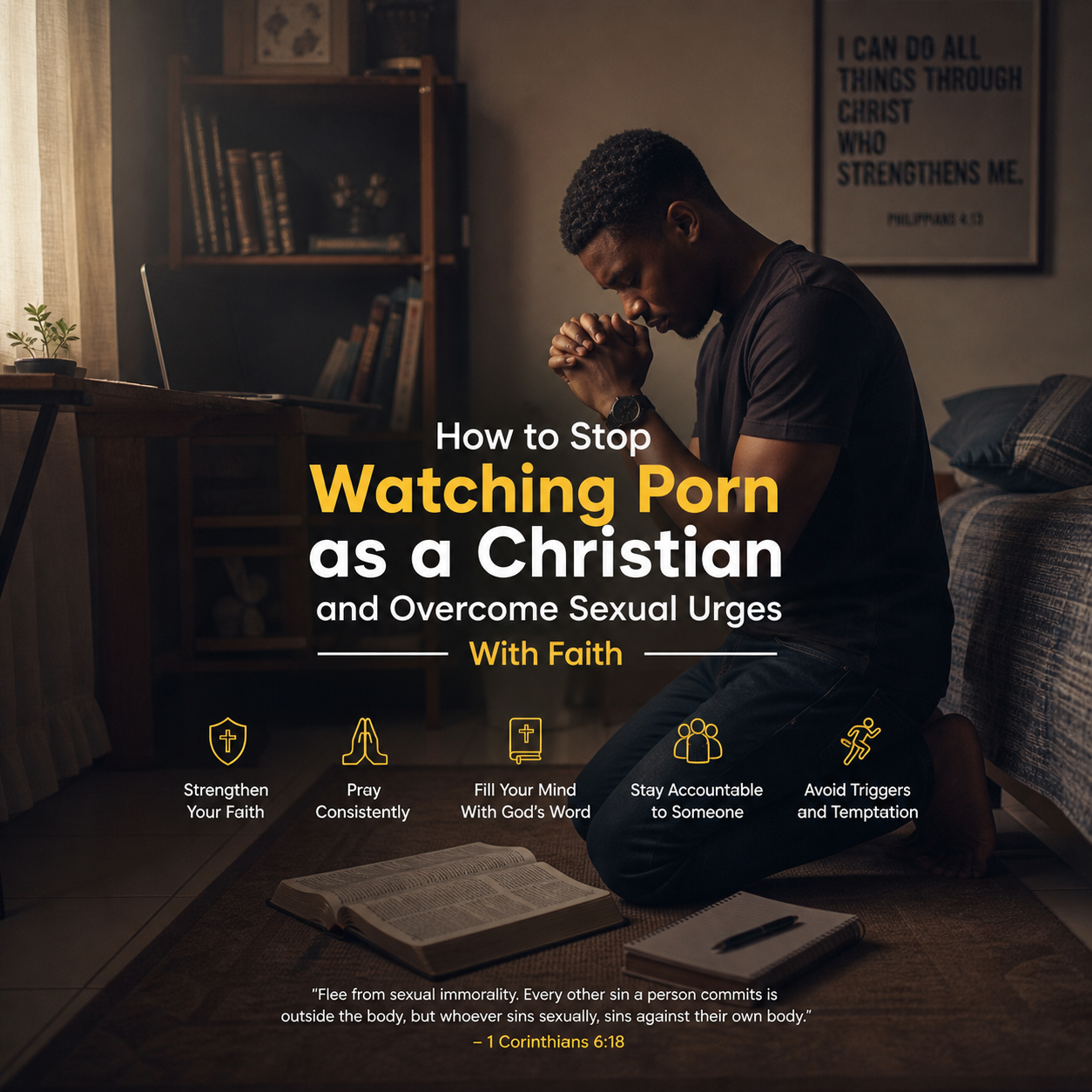
How to Stop Watching Porn as a Christian and Overcome Sexual Urges With Faith
When you are struggling to figure out how to stop watching porn as a Christian, you are not alone in this endeavor, and it is not going to be a conversation treating you like a problem to be solved instead of a person worth knowing.
Pornography is one of the most widely acknowledged and least openly discussed struggles in the modern church. The embarrassment over it is monumental. The leadership silence is nearly universal. And the consequence thereof is that millions of believers are fighting this battle totally by themselves because they feel that they are uniquely broken in a way that God cannot fully reach.
That is a lie the struggle tells you about itself. And to destroy it is the initial actual step towards liberty.
Why This Is Harder for Christians Than Most People Admit
This type of pain is unique to Christians struggling with pornography, and it is unlike the experience of the rest of the population in the same struggle.
When you believe that your body is a temple of the Holy Spirit, that God sees everything, and that sexual purity is a true calling, and you still find yourself going back to something that you sincerely do not want to go back to, the shame that follows is especially cruel. It does not just feel like a bad habit. It is like betraying the most significant relationship that you have ever had in your life.
Understandable, yet also one of the major things that makes people remain trapped. Shame-driven people conceal themselves because of shame. And concealments deprive you of the very relationships, communities and practices that in actual fact bring the conditions of change.
Understanding this dynamic is not an excuse. It is a map. You can also know that the only way to stop the cycle is to break the cycle of hiding by first stopping the hiding.
What Is Actually Happening in Your Brain
This section matters because most Christian content on this subject treats the struggle as purely spiritual and ignores the neurological dimension entirely. The result is that people pray sincerely, feel temporary relief, and then find themselves back in the same pattern and conclude that something is uniquely wrong with them.
What is actually happening in repeated engagement with pornography involves the brain’s reward system. The brain learns through repetition and it does not distinguish between habits that serve you and habits that harm you. It simply reinforces what gets repeated. The more a behavior is repeated, the more automatic the pull toward it becomes in certain conditions.
This does not mean the behavior is beyond choice. It means that breaking a deeply repeated pattern requires more than a single moment of decision. It requires consistent replacement behavior over a long enough period that the brain builds new default responses.
Understanding this is genuinely liberating rather than discouraging. It explains why willpower alone tends to fail in this area and why building new patterns over time is not a sign of weak faith. It is how real and lasting change actually works.
How to Stop Watching Porn as a Christian Starting Right Now
The question of how to stop watching porn as a Christian does not have a single dramatic answer. It has a set of overlapping practices that together create an environment where the behavior loses its foothold.
The starting point is telling one person. Not broadcasting it, not making a public declaration, but choosing one trustworthy person and telling them what you are dealing with. This single action changes more than almost anything else because it ends the isolation that the struggle depends on. You cannot be genuinely known by someone who does not know this about you. And being genuinely known is one of the most healing experiences available to a human being.
The next step is addressing your digital environment. This is practical and unglamorous and it works. Putting filters on your devices, removing apps that create easy access, and restructuring your late night phone habits are not signs of weak faith. They are signs of self knowledge. You are not testing your willpower unnecessarily. You are taking away the opportunity because you know how the patterns work.
Galatians 6:1 speaks about restoring someone caught in a fault with a spirit of gentleness.
The principle behind that verse is community restoration. You were not designed to overcome your most significant struggles alone. The church was given to you in part for exactly this kind of battle.
The Replacement Principle and Why It Works Better Than Resistance
One of the most practical and underused tools for breaking this pattern is the replacement principle. Pure resistance, the effort to simply not do the thing, has a well-documented limitation. It keeps your attention fixed on the very thing you are trying to avoid.
The replacement principle works differently. Instead of trying to fight the urge head on every time it appears, you build a specific alternative response that you go to when the urge arrives. It does not have to be elaborate. It needs to be consistent and genuinely engaging.
Some people use exercise. Some use music or worship. Some use a phone call to their accountability partner. Some use a specific passage of Scripture they have memorized for exactly this purpose. The specific replacement matters less than the consistency of using it. Over time, the new response begins to rewire the automatic reaction to the triggering conditions.
This is not a technique that works overnight. It is a practice that builds momentum over weeks and months. But those who stick with it are always reporting that the attraction toward the previous behavior does indeed weaken over time. Not because the temptation will be removed but because the other route will be more natural.
What to Do When You Fall Again
This paragraph is significant since a majority of individuals who have difficulties with pornography have attempted to quit several times. They have experienced the ups and downs of success and failure which seemed to be disastrous. And the way they responded to that failure often determined whether they got back up or stayed down.
The worst reaction to an error is the prolonged shame and alienation. The person that fails and then withdraws in prayer, in the community, in Scripture, in accountability, is in a much more vulnerable situation than is the person that fails and promptly returns to God without elaborate self-punishment.
Psalm 51 is the most honest record in Scripture of a person coming back to God after a serious moral failure.
What David models in that psalm is not self-flagellation. It is honest acknowledgment, genuine sorrow, and an immediate return to relationship. That is the model worth following.
Getting back up quickly matters. Not because the failure was not serious but because the duration of the withdrawal is what gives the struggle its next opening.
The Connection Between This Struggle and Deeper Emotional Needs
Here is something that most articles on this topic do not say but that reflects the experience of many people who have found genuine freedom.
For a significant number of people, pornography is functioning as a coping mechanism for something that has nothing to do with sexuality directly. It is addressing loneliness. It is managing anxiety. It is offering some kind of emotional release of stress or grief or a feeling of inadequacy that has no other outlet.
When so, it is like treating an effect without addressing the underlying condition when dealing with pornography. The individual will continue to do so not because he/she lacks the willpower but because the underlying need still makes its demands and the conditioned response to that need remains in place.
When that is the case then it is comparable to treating a symptom of a condition that is being treated. This is why such a pronounced difference can be achieved by exerting efforts under the guidance of a Christian counselor rather than trying to white-knuckle through the behavior per se. It may be necessary to identify what is actually being responded to by the behavior and address that underlying, rather than just the surface pattern.
Frequently Asked Questions
Q1. Is pornography addiction a real thing or just a lack of self control?
The research on this is genuinely nuanced. The question of whether the clinical term addiction can be applied in all cases is a debate amongst professionals.
Q2. Is it possible that someone who has grappled with this problem over many years can be permanently liberated?
Yes. The duration of the struggle does not determine the ceiling of freedom available.
Q3. Should couples talk about it when one of the couple has a problem with it?
Yes, and such doing is one of the most significant acts of truthfulness in a Christian relationship. When a spouse learns this on their own, they are likely to experience a much greater sense of betrayal as compared to one who was told directly.
Q4. Are there specific scripture passages that help most in this battle?
Different passages resonate differently for different people. It is a grounding Psalm 51, which many find grounding in the wake of a failure. Romans 8 is powerful for those battling shame and condemnation.
Q5. Does accountability software on devices actually help?
Yes, to many people. It is not that the software makes things purer but that it creates the awareness that somebody you trust will notice what occurs on your devices.
Conclusion
The process of figuring out how to stop watching porn as a christian is one of the most honest journeys a believer can take. It requires honesty about the struggle, honesty about what feeds it, and the kind of courageous vulnerability that the church does not always make easy but that God consistently honors.
You are not too far gone. It is not too deep of a pattern. The shame does not get the final word. Grace is what has the last word.